Roofing Business Systems: The SOG Method Explained
Roofing Business Systems: The SOG Method Explained
Roofing business systems are the difference between owning a company and being the most expensive employee in it. If every crew question, every supplement, every callback still routes through your phone, you do not have a business yet — you have a job that happens to have your name on the truck. A practical systems audit follows a job from lead intake to inspection, estimating, production, invoicing, and collections. Record where decisions stall and assign an owner and clear completion standard to each handoff.
The short answer: the SOG Method splits a roofing company into three parts you can actually manage — Service, Operations, and Growth. You put someone accountable over each one, give them measurable numbers, and stop being the single point of failure. That is what makes a company run when you are not in it.
Key Takeaways
- Roofing business systems come down to three buckets: Service, Operations, Growth.
- Service means someone other than you owns client satisfaction, warranties and referrals.
- Operations means written procedures and automation, so the work does not live in your head.
- Growth means marketing, partnerships and new markets — the part that only gets attention once the first two are handled.
- Every role gets its own numbers. Accountability is a metric, not a mood.
The night this clicked
Justin learned the SOG Method at a rugged property outside Amarillo, Texas — no conference hotel, no slide deck. A practical systems audit follows a job from lead intake to inspection, estimating, production, invoicing, and collections. Record where decisions stall and assign an owner and clear completion standard to each handoff.
Dirk was not there to talk about closing more jobs. He was there to explain why the men in that circle were all stuck in the same trap: they had confused being busy with being in charge.
For eight years in Austin, Justin had told himself he had to do everything because nobody else could do it to his standard. That is not laziness or ego. It usually comes from caring. But it has a ceiling, and the ceiling is you. No matter how good you get, one person can only absorb so much before something breaks — usually your health, your marriage, or your margins.
What are the three parts of the SOG Method?
Dirk's framework had three pillars, and the order matters. Service holds the company up, operations keeps it running without you, and growth is what you earn the right to chase once the first two are solid.
Service
Service is the foundation. Everything else falls over without it.
- Put one person in charge of client satisfaction, warranties and follow-up. Not you.
- Set measurable goals for client feedback, referral rate and retention.
- Treat a warranty call as a system, not an emergency.
The test is simple: if a customer called your office today unhappy, would the outcome depend on whether you personally picked up? If yes, service is not systematized.
Operations
Operations is the machinery that lets the company function without constant oversight.
- Write a standard operating procedure for every repeatable task.
- Automate what can be automated — CRM, scheduling, follow-up sequences.
- Assume every process will one day be run by someone who has been there two weeks.
Growth
Growth is scaling on purpose instead of by accident.
- Give real time and budget to marketing, branding and partnerships.
- Track it with numbers you actually read: revenue growth, market share, team performance.
- Do not chase growth while service and operations are leaking. You will just scale the leak.
Operator vs owner: what actually changes
| | Operator | Owner |
|---|---|---|
| Where decisions happen | Your phone | The person accountable for that area |
| How work gets done | From memory, yours | From a written procedure |
| What you track | Whatever is on fire | KPIs per role, reviewed quarterly |
| What a vacation costs | Revenue and sleep | Nothing |
| What the company is worth | Very little without you | It can be sold |
Why a business that runs without you is worth more
The goal is not just a calmer week. A company so well-structured that it does not depend on any one person — including you — is an attractive asset. Even if selling is nowhere on your horizon, running it that way is what makes it scalable and durable.
That shift is the whole point. Justin came home from Amarillo and started handing over the day-to-day so he could work on the parts only an owner can do: securing larger contracts, building partnerships, opening new markets. Today every person on his team has KPIs tied to their role, and they meet quarterly to review them. The structure holds people accountable, and it also gives them a way to win.
How to start this week
1. Write down every decision that came to you in the last seven days.
2. Sort each one into Service, Operations or Growth.
3. Pick the bucket with the most entries. That is your bottleneck.
4. Name one person accountable for it and agree on two numbers they own.
5. Write the procedure for the three tasks that came to you most often.
You are not trying to fix the whole company this month. You are trying to remove yourself from one bucket at a time.
Get the playbook
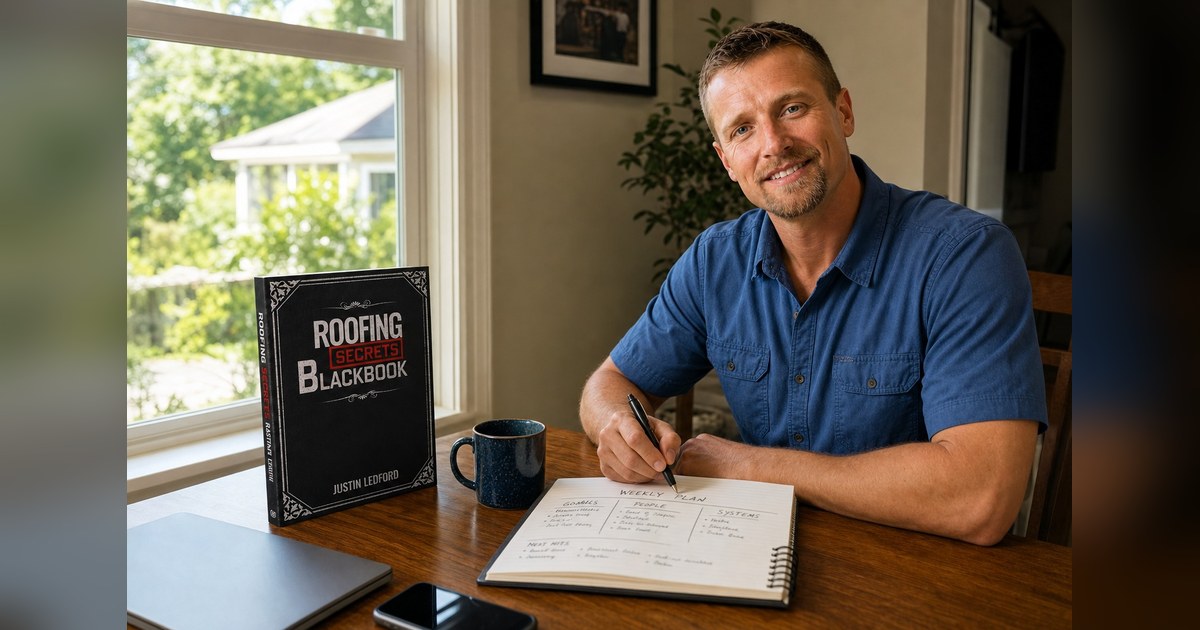
The SOG Method is one chapter of the *Roofing Secrets Black Book* — Justin Ledford's system for taking a roofing company from owner-dependent to owner-optional. The full book covers the recruiting engine, the operating system, the money buckets and the automation stack, with the frameworks laid out step by step.
Get the Roofing Secrets Black Book at roofingsecretsblackbook.com and start with the chapter that matches your bottleneck.
