How to Get Roofing Leads Without Buying Them
How to Get Roofing Leads Without Buying Them
Every roofing owner has done the math on purchased leads at least once. You pay per lead, you share that lead with three competitors, you win maybe one in six, and your acquisition cost quietly becomes the largest line item in the business. Getting roofing leads without buying them is not a trick — it is a set of five channels that most companies own already and never work systematically.
The short answer
The five roofing lead sources you do not have to pay a vendor for are past customers and referrals, canvassing after storms, your Google Business Profile and local search presence, relationships with adjusters, agents and property managers, and your own database of unsold estimates. Every one of them is slower to start than a purchased lead and dramatically cheaper once running.
Key Takeaways
- Purchased leads are the fastest and the most expensive; they should be a supplement, not a foundation.
- Your unsold estimate list is the cheapest lead source in the business and almost nobody works it.
- Referrals do not happen by accident — they happen because someone asked at the right moment.
- A complete Google Business Profile with steady reviews outperforms most paid channels locally.
- Every channel needs an owner and a weekly number, or it quietly stops happening.
Start with the list you already have
Somewhere in your CRM is every estimate you wrote and did not sell in the last three years. Those people had a roof problem, let you onto their property, and did not buy — usually because of timing, money or a competing bid.
Some of them still have the problem. Some have had another storm since. Almost none of them have heard from you.
Working that list is close to free and requires no new marketing. Sort by date, start with the most recent, and contact each one with something useful rather than a sales call — an offer to re-inspect after the most recent storm works because it is genuinely relevant.
Referrals only happen if you ask
The most common referral strategy in roofing is hoping. Companies do good work, assume the customer will mention them, and never ask directly.
Ask at the right moment: the day the job is finished and the customer is happiest, standing in their driveway looking at a new roof. Not by email three weeks later. The ask is simple — is there anyone else on the street or in the family whose roof took the same storm.
Then make it easy. Leave something physical. Follow up once. A structured referral habit typically outperforms every paid channel a roofing company runs, and its cost is a conversation.
The five channels compared
| Channel | Cost | Speed to first job | Consistency |
|---|---|---|---|
| Past customers and referrals | Very low | Slow to build, fast once running | High |
| Canvassing after storms | Labor only | Fast | Weather-dependent |
| Google Business Profile and local search | Low, time-heavy | Slow | High once ranked |
| Adjuster, agent and property manager relationships | Low | Slow | Very high |
| Unsold estimate database | Near zero | Fast | Depends on list size |
| Purchased leads | High | Immediate | Consistent while you pay |
Notice the last row is the only one where consistency stops the moment you stop spending. That is the structural problem with building a company on purchased leads: you are renting your pipeline.
Local search is a channel, not a website
Most roofing companies treat their online presence as a brochure. It is a lead channel, and the part that matters most locally is the Google Business Profile rather than the website: complete information, correct and consistent name, address and phone, real photos of your jobs, service areas, and a steady flow of reviews.
Reviews are the piece owners underinvest in. A steady trickle beats a burst — twenty reviews arriving in one week looks exactly like what it is. Build the request into job completion so it happens without anyone remembering to do it.
Relationships that send work repeatedly
Insurance adjusters, independent agents, property managers and real estate agents all encounter roof problems as part of their week. They refer to companies that make them look good: show up when promised, document properly, and do not create problems they have to clean up.
These relationships are slow to build and extremely durable. One property management company can produce more work in a year than a month of purchased leads, and it does not stop when the marketing budget does.
Give every channel an owner and a number
This is where most of this advice dies. Every channel above works. None of them works without someone accountable for it and a weekly number attached: referrals asked, reviews requested, unsold estimates contacted, relationships visited.
Without that, all five get done in bursts when work is slow and abandoned when it is busy — which is exactly backwards, because the slow period is created by not having worked them three months earlier.
The Small Business Administration's general marketing and sales guidance is a reasonable neutral primer if you are formalising this for the first time.
Where this fits in a profitable roofing company
Lead cost is one of three levers on roofing profit, alongside pricing and production efficiency. Fixing acquisition cost while pricing jobs badly just loses money more efficiently — how to price roofing jobs for profit covers that side, and why roofing companies stop growing covers the ceiling most owners hit next.
The whole system is in the book
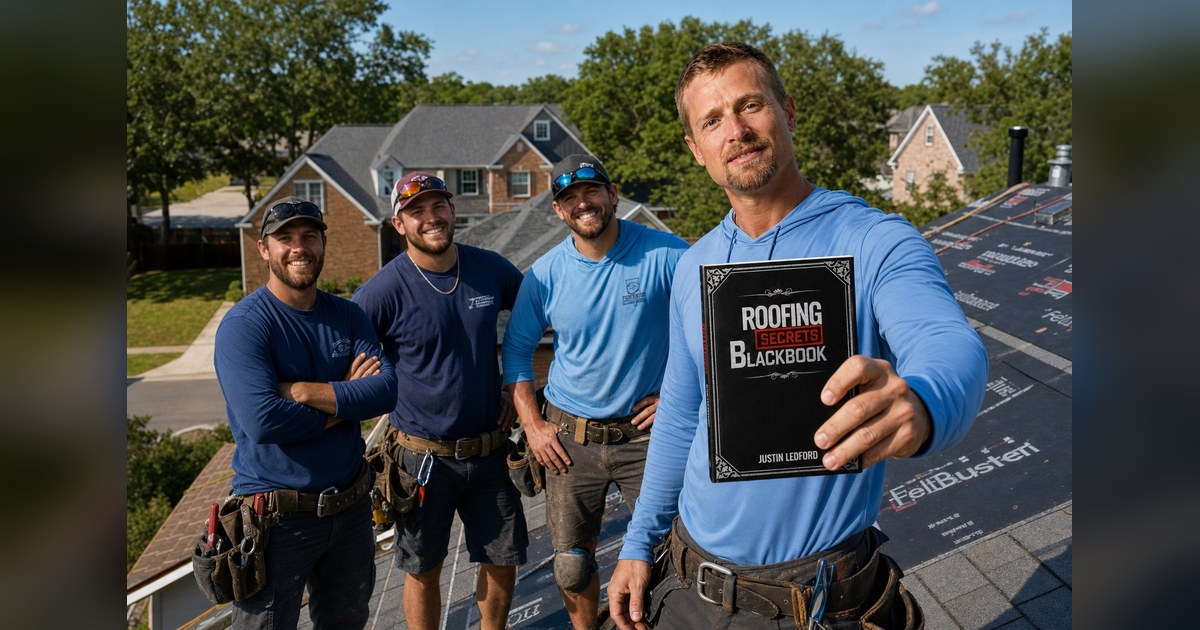
The Roofing Secrets Black Book lays out the system we used to build an eight-figure roofing company, including the lead channels above and how they fit together. It is $7.95, it comes with a 30-day guarantee, and it is a faster read than this problem is to solve by trial and error.
Get the Roofing Secrets Black Book and start with the chapter on acquisition cost.
