The 4-Sentence Text for Roofing Team Updates
The 4-Sentence Text for Roofing Team Updates
In 2018 a thriving roofing company lost a million-dollar contract because a project manager did not pass on a deadline. The sales team, not knowing it was urgent, worked on other things. By the time they moved, the client had chosen a competitor. The 4-sentence text is a format designed so that cannot happen — four lines that carry clarity, context, an action and an invitation to ask.
The short answer: every message to your team gets four sentences — what the fact is, why it matters, what you want done and by when, and an explicit opening for questions. It takes thirty seconds longer to write and removes most of the ambiguity that costs roofing companies jobs.
Key Takeaways
- Four sentences: clarity, context, call to action, open for questions.
- Most costly miscommunication is not disagreement — it is a missing "why".
- People act on urgency they understand, not urgency they were told about.
- Say explicitly that re-asking is welcome, or people will guess instead.
- It is better to be asked the same question twice than to absorb a million-dollar mistake.
What the four sentences are
Here is the message the 2018 project manager should have sent, in the format that would have saved the contract.
Step One: Clarity — state the fact
"The deadline for submitting the bid is this Friday."
No preamble. The single most important fact, first, in a sentence someone can repeat accurately to a third person.
2. Context — say why it matters
"The client has emphasised that timeliness will heavily influence their decision."
This is the sentence that gets skipped and the one that does the work. A team told *what* will fit it around their existing priorities. A team told *why* will reorder them.
3. Call to action — say what happens next
"Please prioritise drafting the proposal today and submit it for review by 5 PM."
Name the action, the owner and the time. "As soon as possible" is not a deadline, and it is understood differently by every person who reads it.
4. Open for questions — invite the follow-up
"Let me know if you need additional details or support."
Explicit permission to ask. Without it, someone who is uncertain may proceed without asking for clarification.
Before and after
| | Typical message | 4-sentence text |
|---|---|---|
| The fact | Buried mid-paragraph | First sentence |
| Why it matters | Assumed | Stated |
| The ask | "Can someone look at this" | Named person, named action, named time |
| Questions | Implicitly discouraged | Explicitly invited |
| Likely outcome | Fits into existing priorities | Reprioritised the same day |
Why the fourth sentence matters more than it looks
Most roofing teams have an unspoken rule that asking twice looks weak. That rule costs more than any single mistake, because it converts every ambiguous message into a guess.
Tell people directly: if you are confused or need to re-ask something, do it, and there will be no consequence for it. It is far better to put up with the inconvenience of repeated questions than to carry the cost of one misunderstanding. The 2018 example is the whole argument — one unasked question, one lost contract.
Why this works better than a longer message
The instinct when something is important is to write more. It usually makes things worse. A long message forces the reader to work out which part is the instruction, and under pressure they will pick wrong or skim.
Four sentences does the opposite. It forces the sender to decide what actually matters before they hit send, which is the real work. Most unclear messages are not badly written — they are messages sent by someone who had not finished thinking, passing that unfinished thinking to somebody else.
There is a second effect worth having. Because the format is fixed, your team learns to read it quickly: the fact is always first, the deadline is always in the third line. That predictability is what makes it fast to act on, and it is the same reason a fixed meeting agenda outperforms a better-intentioned open discussion.
Where to use it
- Anything with a deadline attached.
- Anything where you are handing work between departments.
- Anything you would be annoyed to discover was not done.
- Anything going to someone who was not in the room when it was decided.
Ordinary day-to-day chat does not need it. The format is for messages that carry consequences.
Practise it this week
1. Take one live project and write the update as four sentences.
2. Share it with the team and ask whether anything was unclear.
3. Refine the wording based on what they say, and keep the version that works for your company.
4. Use it for every deadline message for two weeks.
5. Notice how many follow-up questions you stop receiving.
The measure of success is not that people compliment your messages. It is that fewer things arrive late for reasons nobody can explain.
Communication is a system, not a personality trait
Plenty of owners assume they are bad at this or that their team is. Usually neither is true — there is simply no agreed format, so every message reflects whatever mood the sender was in. Giving communication a structure does the same thing that giving a job a procedure does: it makes the outcome repeatable by someone other than you. That is the same logic behind running a weekly meeting on a fixed agenda.
Get the playbook
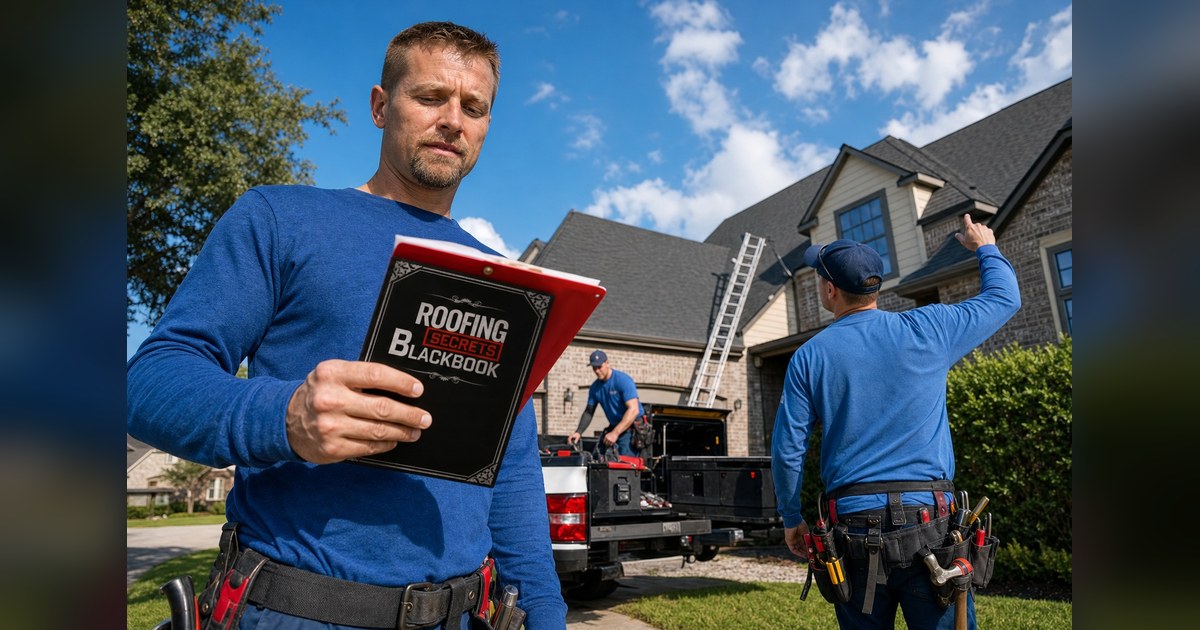
The 4-sentence text is part of The Art of Communication chapter in the *Roofing Secrets Black Book*, alongside using group chat for real-time updates and running a sales board that turns goals into results.
Get the Roofing Secrets Black Book at roofingsecretsblackbook.com.
